
WHSQ Updates to Scaffold Step Height Guidance – Implications for Industry
Workplace Health and Safety Queensland (WHSQ) has released a revised version of its guidance titled Safe scaffold step height during construction work (February 2026).
The revised version contains several important changes that clarify and strengthen WHSQ’s compliance expectations in relation to scaffold step heights between bays and hop-up platforms.
The revised guidance provides clearer direction on how inspectors are likely to assess scaffold step heights on construction sites and introduces new practical expectations for managing this risk.
This article outlines the key differences between the previous and current versions and explains what these changes mean for scaffold businesses and workers.
Stronger link between the 300 mm limit and WHS legal duties
In the previous version, WHSQ stated that step heights should not exceed 300 mm. This was presented as good practice guidance.
The updated document now states that step heights mostly used for access and egress should not exceed 300 mm so far as is reasonably practicable.
This wording directly links the 300 mm limit to how compliance with the health and safety duties under the Work Health and Safety Act can be achieved. The expectation is no longer presented as general guidance but as a minimum compliance benchmark that should be met unless it can be demonstrated that it is not reasonably practicable to do so. Other methods that provide an equivalent or higher standard of work health and safety can also be followed, such as a technical or industry standard.
This represents a significant strengthening of the regulator’s position.
Formal recognition of stepdown brackets as an acceptable control measure
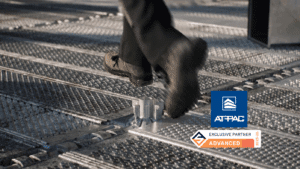
The revised guidance introduces an important clarification that did not appear previously. WHSQ’s position is that a stepdown bracket: does not constitute a stairway flight under AS/NZS 1576.1
This clarification confirms that the installation of stepdown brackets between scaffold bays does not trigger the stairway requirements contained in the Standard.
This removes a long-standing area of uncertainty and clearly identifies stepdown brackets as an appropriate and recognised method of controlling excessive step height between bays.
Additional guidance for consistent step heights between platforms
The updated document provides clear expectation: Scaffolders should ensure the step heights between the two platforms are consistent to reduce the risk of a misstep which could lead to a potential trip and/or fall.
This requirement did not appear in the earlier version and provides inspectors with clear guidance to question inconsistent rises between platforms.
Additional guidance to visually highlight steps where consistency cannot be achieved
Where it is not reasonably practicable to maintain consistent step heights, the guidance now recommends that the step be visually highlighted, for example using contrasting slip-resistant tape.
The addition of this expectation reinforces WHSQ’s focus on trip prevention and safe access and egress for workers.
Removal of the “250–300 mm safe range”
The previous guidance described a “standard safe step height” as being between 250 mm and 300 mm.
This reference has been removed. The updated document now only refers to not exceeding 300 mm.
This change presents 300 mm as a clear upper limit rather than part of a range.
Reframing of the hazard as an access and egress risk
The earlier document referred to a 500 mm step height as “unsafe”. The revised guidance instead describes it as an excessive step height mostly used for access and egress.
This reframing aligns the issue with general workplace access duties under the WHS Regulation rather than scaffold integrity requirements. The document now repeatedly links excessive step heights to trip hazards and musculoskeletal injury risk.
Broader application to hop-ups used for access
The wording has changed from “primarily used for access” to “mostly used for access and egress”, broadening the circumstances where the 300 mm expectation applies.
Practical implications for SAA members
The numerical limits have not changed. The 300 mm and 500 mm figures remain the same.
What has changed is the clarity of WHSQ’s expectations:
Excessive step heights used for access should be controlled so far as is reasonably practicable
Stepdown brackets are recognised as an appropriate control
Step heights between platforms should be consistent
Steps should be visually highlighted where consistency cannot be achieved
The 300 mm limit is now clearly tied to WHS legal duties
Key considerations for scaffolders
When erecting tiered scaffold bays or installing hop-up platforms, scaffolders should now assume that:
A 500 mm step used for access will be subject to scrutiny
Stepdown brackets should be considered as a standard control measure
Step rises between platforms should be kept consistent
Step edges should be visually identified where required
There should be a clear ability to demonstrate how step height risks have been managed so far as is reasonably practicable